
Dynamic Agents
Introduction
July 22, 2026
Autonomous Agents
We can generalise agentic systems beyond fixed workflows (that can choose between a fixed series of tools), allow such a system to create its own tools that it can use again within the Agentic Loop that its running.
The previous section was all about building 'harnasses'. That is LLM-based workflows, that perform relatively deterministic processes. And thought the exact path through the system might depend on the input, the system itself remains well defined.
These 'static systems' of the previous section contrasts with 'dynamic systems', where the whole graph of the process is not defined before the system is run, but might be spontaneously generated by the system itself.
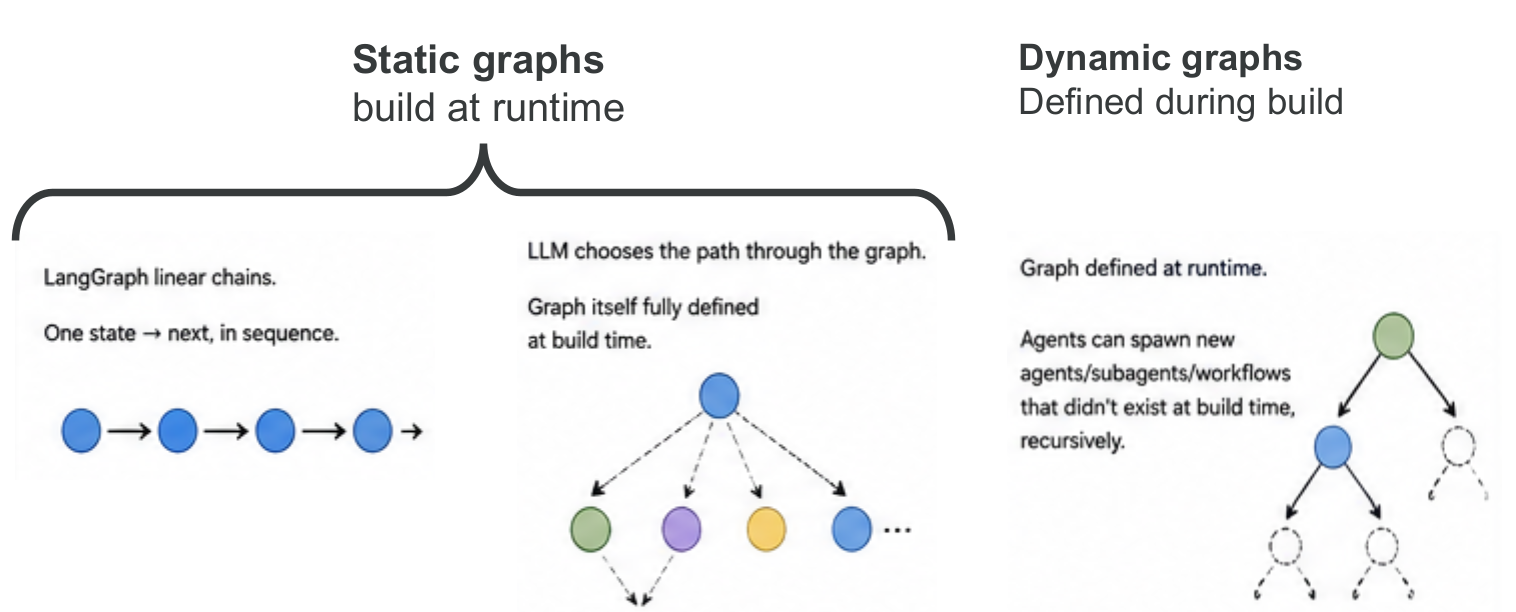
This setup (an agent that can create its own tools and sub processes) is what we mean in this section when we talk about Dynamic or 'Autonomous' AI Agents like Claude Code (at least when you run it with full permissions).
How this section differs from the previous one
In this section, rather than discussing how to build a static agentic harness, that performs a task, and our challenge being to evaluate how well it performs the task it was designed to do.
We will assume that we have constructed and tested a predefined agentic harness. And are mainly concerned with the challenge of evaluating how well it performs the entire process of dynamically generating the graph of the steps that it will follow, look up other tools and systems that it might want to use from registries.